Showing posts with label Barcelona sites: Museums and exhibits. Show all posts

Wednesday, February 8, 2012

A cross for Tàpies

Two days ago, on February 6th, Antoni Tàpies passed away.
Born in 1923, he was one of the leaders of the Spanish avant-gardes and perharps our most internationally renowned artist of his generation, with his works displayed in over 100 museums throughout the world.

His style was based in abstraction, but full of symbolism at the same time. Politically committed with the Catalan nationalism, his art reflected both his love for his land as well as his research of spirituality through the simplicity of things. He was innovative in the use of materials, and often ahead of his time in his projects (some of them, such as the Sock, had to wait a couple of decades before people were ready to accept and value it as leading artwork).

Crosses were one of his favorite symbols, probably because their many layers of interpretations. A cross can refer to our Christian heritage, but it can also be used to scratch or to mark something. It can represent death, and it can be a T, the T for Tàpies. His signature.

Now Tàpies has left us. Let's paint a black cross in his honour.

         Photo credit

Other posts on Antoni Tàpies in this blog:
http://foreverbarcelona.blogspot.com/2011/02/saturday-afternoon-at-tapies-foundation.html
http://foreverbarcelona.blogspot.com/2010/03/tapies-foundation-finally-reopened.html


**** To know more about my Barcelona tours, visit Foreverbarcelona.

Sunday, November 6, 2011

"The Ladder of Escape" at the Miró Foundation


Until next March, the Miró Foundation is displaying out once in a lifetime temporary exhibit: "The Ladder of Escape". This show has already been a total success in the Tate Modern in London, and will be heading afterwards to the National Gallery of Art in Washington.

This is a unique opportunity to see together over 150 works by the artist that are rarely seen together, many of them hardly ever leaving their places of origin.

The name of the exhibit refers to one of the symbols that Miró used more often in his works: a ladder representing his need to escape from the tough events that Europe had to endure during the first half of the 20th century, and his wish to reach a world of poetry in the starry night of his dreams.


Although it is not conceived as a retrospective of the artist, it does cover most of Miró's evolution: from his early years of detailist paintings imbued in Catalan influences, to the anguish of the Spanish Civil War and World War II reflected in his tortured deformed figures, to the birth of his celebrated symbology made of birds, moons and stars, to the influence at the end of his life of the American avant-garde and the Japanese art that took him to a word of expressivity, lyricism and minimalism.

The exhibit opened a couple of weeks ago, but I've been so busy I couldn't find a moment to check it out. However, I have made some research in case a client asked me to take them there. And that was a good idea!

The Ustundag asked me give them a tour of the Miró Museum today, and even if I hadn't been there yet, I managed to give them a pretty good tour! The only ifficulty was that I didn't know what I was going to find in each room, nor how the works would be displayed. But I had enough information, and being very familiar with the usual permanent collection, I was able to create a decent line of speech. Anyway, I can wait to be less busy and have a free morning to spend there preparing it even better!

By the way, since the new exhibit opened there's been long lines in the Museum. Good thing that official tourguides get to skip them!


**** To know more about my Barcelona tours, visit Foreverbarcelona.

Sunday, October 16, 2011

Special visit of the temporary exhibit at the Picasso Museum

The Picasso Museum has been displaying a great temporary exhibit since July, in collaboration with the Van Gogh Museum of Amsterdam about the first years Picasso stayed in Paris.

"Feasting on Picasso" explores how the cultural and social life in Paris quickly influenced his art, introduces us his marchands, friends and lovers and follows the evolution of his style comparing it to the masters of the impressionism such as Van Gogh, Toulouse Lautrec and others, until everything explodes into the emergence of cubism.


I was really happy when I received a call from Sandra from Contempla, one of the top travel agencies in Barcelona, asking me if I could give a special tour of the exhibit for one of their groups. Feasting on Paris had been in my "must-see" list since it was innaugurated, but this season has been so busy I hadn't had the opportunity to go yet.


I had a few hours of free time, so I run to the Picasso Museum to prepare my museum tour: I walked around the rooms taking notes, sat to read the catalogue, and then back home I did some more research on the internet and the books on Picasso I have at home. It was a very productive day!

I gave the museum tour on Friday, and even if the clients had less time for it than it had been planned at first, I manage to give them a nice overview, and I got congratulated for the job. I'm so happy to get this opportunities to share my passion for Picasso with other people! Plus temporary exhibits are a great way to refresh my knowldege and open-up to new points of view about the permanent collection aswell!

**** To know more about my Barcelona tours, visit Foreverbarcelona.

Wednesday, July 27, 2011

The Romanesque Section of the MNAC is back!


After being closed for several months for restructuration of the display, the Romanesque Section of the MNAC has been finally reopened to the public.


Nonetheless, this is the most important collection by far there! You won't find such a large selection of Romanesque frescos anywhere else: they were carefully removed from their churches of origin in the Pyrenees before collectors with no qualms bought them for almost nothing to take them into their own countries. Then real size exact copies of the churches structures where built in plaster, to home the frescoes who were reglued there. Simply unique!
Plus that's not all, the Romanesque section also includes altar fronts (religious paintings on wood), crucifixes and cross descent groups (wooden sculptures) as well as silverwork.


The purpuse of the restructuration of the way the collection was displayed was simplyfing the understanding of this art period (the number of pieces of artwork has been reduced to a small number of selected pieces of the highest quality) as well as to create a more intimate athmosphere that remided that of the medieval churches. They were quite limited by the type of art that is displayed (they couldn't move around those huge plaster apses, of course!), but they made a beautiful job playing with the lights and the shadows and distributing some of the pieces in locations where it'd made sense they were if they were inside a real church.

Can't wait to be asked to take someone there on a museum tour!!!

Saturday, May 28, 2011

Two great sites are back!!!!

What an exciting month has been March!
Two really good sites have just been reopened to the public after years of being closed for refurbishment works. I'd missed them so much!
So taking advantage of a last-minute cancellation, I spend a whole morning exploring them in depth. What a privilege!


First of all, a must-see Gaudí site: The Palau Güell, a private mansion built for his best friend and benefactor Eusebi Güell that is considered a precursor of the masterpieces he'd be building later on.

The visit includes the entrance hall, the basement where the stables were located, the main staircase, the main floor with all the social areas (dinning room, lost-steps room, reception rooms... as well as the impressive central room with its magnificent hyperbolic dome) as well as the back patio, then it continues with the upper floor where thEnllaçe private dormitories where located, and it finishes with the attic (now used for an exhibit on the building restoration process) and the fairy-tailish rooftop where Gaudí was already starting to play with the smokepipe shapes.

Unfortunately, the structure of the building is very delicated and the access is limited to only 185 people at a time and tourguides will not be allowed to skip the entrance lines with small groups (as we are used to have the privilege to do in most other sites). But if you are interested in visiting it with me, we can always meet directly there and I'll be there a bit early to make sure to get the tickets for the right time!


The other wonderful museum that just reopened is the Museu Marès. Frederic Marès was one of the most important Catalan sculptors of the early 19hundreds, and he was also an avid collector. This museum displays his collections: a huge sculpture collection not of his works but mostly of religious christian sculptures from the middle ages upto Marès times, as well as his "collector's cabinet" showing daily life objects from the 17 to the early 19hundreds including all kind of fans, women jewelry, smoking pipes, ceramic, weapons, clocks, toys, toilettery...

While I must say visiting the whole museum listening to the audioguide point by point was quite exhausting (it took me 3h!!), I'd probably recomend only people who are very interested in medieval art visit the street level where the sculpture collection is, and the rest go straight to the upper floors to enjoy the Collector's Cabinet. It can be fun even for kids! Just do it lightly, because it can again be overwhelming at some point!
Anyway, I'm planning to take my grandparents there next week as I'm (so far!) still available on Tuesday. I'm sure they'll love to see all this old stuff

Sunday, April 24, 2011

Touring on Shabbat

Observing the Shabbat rules doesn't have always to stop you from visiting a beautiful town as Barcelona. It just requires a bit more planning than usual and of course some more walking, but a good local guide can help making things much easier for you!

Yesterday I was with the Applbaum group and I took them to the Montjuic Hill. We had carefully planned all of our itinerary and needs beforehand. They had already purchased in advance their Articket cards (which I'd be carrying) to avoid using money for entrance fees and I had pocket money to provide water during the tour.


From their hotel conveniently located within walking distance from one of the city synagogues, we walked down to Plaça Espanya, then uphill to the MNAC Museum. It's a gorgeous place and its collection is huge, so we decided we'd be focusing on the upper floor where the modernist paintings are. The Romanesque section is closed for refurbishment until June anyway, and they had already seen enough Gothic art during the rest of their trip. They were amazed to see the high quality of our local 18th hundred artists!

After that, we crossed some pretty gardens and continued uphill to the Montjuïc Castle. We enjoyed the city views from there, freshened up and let the kids play with the canons for a while.


On the way down, I showed them the field where the Jewish Cemetery had once been in the Middle Ages and told them a bit about our Jewish History. Unfortunately, nowadays there is nothing to be seen in this place as some tombstones are now in museums or embeded as part of medieval buildings and the rest is buried, waiting to see if our City Council and the modern Jewish community agree on a respectful project to honour the place.

We also had a short stop at the Olympic Stadium, then walked back to the hotel passing the MNAC and Plaça Espanya, the same way we came.

We spent a total of 6h for the whole tour (but it could have been less, because we were a bit late departing the hotel when we started).

I am born a Christian (although I don't really practice), so I don't know the Jewish traditions and rules in depth, but thanks to my job I'm getting familiar with Shabbat habits and it's a pleasure for me accomodating to my clients needs and helping them get the best Barcelona experience they can!

Monday, March 28, 2011

Innaguration days!

As locals say... when the local elections approach, plenty of things are innaugurated. And that's what's happened last week, when two main brand new sites have just been open.

The first one I want to talk about is Las Arenas shopping mall, former bullfight ring that after 3 decades of beeing closed is finally starting a new life and it's called to become a very popular shopping and food hub that will definitely be appreciated by the visitors of the Montjuïc Hill aswell as the participants to the many trade fairs organized in Fira Barcelona. There will also be a wonderful gim with a spa (to be open in May) and also the Museum of Rock, that will definitely become a must for teens and modern music lovers.
By the way, contemporary architecture lovers will be pleased to know the building was refurbished following a project by Richard Rogers. Do you want to learn more? Take one of my contemporary architecture tours!


The other big site is the brand new Museum of Sciences (also called Blue Museum, because it's hosted inside the triangular blue building at the Forum by Herzog & De Meuron - again, good news for contemporary architecture lovers!). This new museum is the result of the renovation of the former Museum of Zoology and Museum of Geology that used to occupied buildings from the 1888 World Fair in the Ciutadella Park. Now their collections and presentations have been modernised and they are going to become a new pilgrimage point for any visitor interested in sciences aswell as for many families with kids.

I'm planning to visit both of them as soon as possible, so stay tunned for more posts on them!

Wednesday, March 2, 2011

A children afternoon


My brother leaves in Andorra, so I don't get to spend much time with my nephew but this week the kid has a school holyday and he's in town. My mom and I decided to take him to Cosmocaixa, the Science Museum and he had an awesome time there!

We had heard there was a temporary exhibit on dinosaure skeletons, and since he LOVES dinosaures, we thought it'd be fun. And yes, the exhibit was a success (we did it twice!), but he also enjoyed so much all the interactive science experiments. Well, not that he's old enough to really understand what they were about (he's only 6yo), but there were loads of buttons to push and things to move! And you know how kids are! ; )

And the biggest surprise was the Flooded Forrest: they have reproduced the Amazonian Forrest environment so you can see it first from outside (huge piranhas!), but then you enter the backside of the glass cage and it becomes a subdued-light terrarium with more fish, and snakes, and spiders and then... you get out to the Forrest Garden. My nephew got so excited! He really felt like he was in a real forrest with all those plants and the birds moving around us. It also started "raining" on the marshland (we didn't get wet, though), and we could feel the warm temperature and the moist in the air. That was SO cool!

So if you are visiting Barcelona with kids, Cosmocaixa is definitely a great place to go for an afternoon. Take either a taxi, or from Plaça Catalunya the FFCC train to Avinguda Tibidabo, then from there the196 bus takes you to the door.

Also, if you are planning to join any of their additional activities such as the Planetarium or the TocaToca, make sure to book them online as they always sell out (yes, even Mon-Fri afternoon in low season!).

And one more thing! The easiest way to visit the Museum is taking the elevator or the scalators to the -5 floor, and from there go back up (as the best part is in the very bottom floor).

Monday, February 28, 2011

Saturday afternoon at the Tàpies Foundation


The Tàpies Foundation is one of the most difficult museums to keep up with, from a local tourguide point of view: they rotate the artwork in display in their "permanent" collection every few months, so it's hard to develop this feel of closeness and almost intimacy we often get to acquire with pieces in other museums such as the Picasso, Miró or MNAC museums where despite some rotation their best works are almost always displayed.

This is why I decided to freshen up my knowledge and resources and joined a public guided tour last Saturday afternoon. I was not the only official guide there, as my colleague Paquita Vázquez had had the same idea, and I found her insightful comments as enlighting as the museum's guide explanations! By the way, I also want to thank her for sending me her own pictures of the famous giant Sock sculpture, even if in the end I decided the ones I took with my phone were good enough for the blog.

The guided tour was structured in 3 parts: first going to the rooftop terrace to see the Sock, then visiting the permanent collection on Tàpies works, and finally visiting the temporary exhibit, nowadays Organigrama, by Ibon Aranberri.

I was a bit disappointed to realize that some good 10min were lost just going up and down stairs. It is true that being an old industrial building connecting the different levels wasn't easy, but itinerary efficiency is one of the rules for a great tour.
And probably if the order had been different we'd have saved up some time and the guide would have been more relaxed, as I could sense she had to respect tour time restrictions (which is not always the guide's responsibility or choice) that forced her to rush over the works.

Also, the Tàpies collection was displayed in one single floor way too small. From the over 700 pieces in their collection only... 18 pieces between paintings, drawings and sculpture were shown! That was probably the most disappointing thing. It felt more like an art gallery than a true museum.
Plus, as I was mentioning before, there wasn't much time to go in depth in most of them so all in all we were given a rough introduction to key themes that repeat through Tàpies evolution (crosses or T's, the sublimation of the humble, materials...).

The rest of the tour (some 10-20min, according to the timings the guide had told me) was dedicated to the temporary exhibit in the basement. But I must admit I didn't stay because my boyfriend and I were invited to a double birthday family dinner in his hometown, Sant Sadurní d'Anoia in the Wine Country, and we had to drive there.

I understand the Foundation's commitment to promote other contemporary artists. The Miró Foundation works along that path aswell, but at least their permanent collection is much more consistent. So it's probably time the Tàpies Foundation finds a larger venue that allows them to continue supporting the younger generations but also puts in relief Tàpies works and approaches them better to the general public. Now it's the time to create deeper relationships between his works and the people, instead of a dizzyness originated by excessive rotation.

By the way, if you are interested in getting the best out of your visit to any Barcelona Museum, don't forget to book one of my Museum Tours.

Friday, November 19, 2010

Romanesque Section of the MNAC closed for renovation works

Big news!
The Romanesque Section of the MNAC will be closed from Nov. 15th to June 2011 for renovation works. This collection, probably the best display of Romanesque church frescoes in the world, will be reorganized in order to improve the visitors experience and renovate the way information and the works are presented.
After seeing the great job they did with the Gothic Section new display (read my post on this here), I can't wait to see what will happen now with the Romanesque! Keep posted for news next June!

Thursday, October 21, 2010

Picasso in front of Degas


Last week was inaugurated the temporary exhibit Picasso in front of Degas at the Picasso Museum. Today I'm spending my rare afternoon off enjoying it and I can't stress enough how much I've loved it.
Although belonging to different generations, they were once neighbors in Montmartre (Paris) and had friends in common - but there is no evidence they ever met. Anyway, Degas was always a reference for Picasso until his late days.
Don't miss the comparisons of each artist visions of dancers and bathing ladies, and the (scandalous!) sense of humor of Picasso portraying Degas amongst prostitutes in his series of engravings.

http://www.museupicasso.bcn.cat

Show on until January 16th, 2011.
Do you want to learn more? Follow my Picasso Tour!
Enviado desde mi dispositivo BlackBerry® de Orange.

Friday, October 15, 2010

The MNAC is in the street!


Walking around Barcelona you might be surprised to see pictures of Catalan paintings placed somewhere that has some connection with the subject of the painting. For instance, beside the gorgeous Gratacós fabric store in Passeig de Gràcia stands a colorfully dressed Granada girl by Anglada Camarassa. Or next to the city council in Plaça Sant Jaume, the gothic retable of the Verge dels Consellers (Madonna of the Counselers) by Lluís Dalmau. All of the paintings can be seen in their original version at the MNAC, but at the Museum they have decided to bring their collections to the street so everyone can enjoy them as they walk around the city. What a wonderful idea!
If you want to discover where the pictures have been placed, check it out here!
Posted by Picasa

Tuesday, June 1, 2010

News at the MNAC and Miró museums!

This morning I went to the hill of Montjuic to check out recent changes in the collections of two great museums, the MNAC and the Miró Foundation.

The Miró Foundation reorganized their rooms a couple of months ago, but I hadn't had time to visit and update. I was happy to locate my favorite paintings in their new locations, and to get acquainted with some other beautiful pieces that had been stored in their warehouse so far. I also loved the way they have recovered the original octogonal shape of the room where now is exhibited his work on paper.
NOTE: Calculate around 1h if we include it in our guided tour.


As for the Museum of National Art of Catalonia, they have just innaugurated a renovated Gothic Art section, and what they have done is unbelievable! I must admit I used to think that this part of the museum was by far less exciting than the Romanesque section with its impressive milenary frescos or the Modernist section, best collection in town about such a bright and creative period in our history. But now it might become my very favorite section in the museum!

The MNAC has worked hard restoring their retables, and I find the renovated Gothic section fascinating for the beauty of the colours of the retables as well as for the wonderful stories these paintings explain: miracles, saints tortured, evil punished, donnors showing off, medieval dayly life... I agree, for people who aren't familiar with all this, the visit can be a bit overwhelming. But trust me: with a good tourguide like me, it can be so much fun!
NOTE: The MNAC is huge! To see the whole museum we'll need a whole halfday tour (4h). The highlights can be seen in around 2h, but then you have to trust me, keep up to my pace and don't linger where I don't stop! And to see only one section, it's usually around 1h... but after seeing the new Gothic section I believe it could easily go upto 2h!!!

Wednesday, May 12, 2010

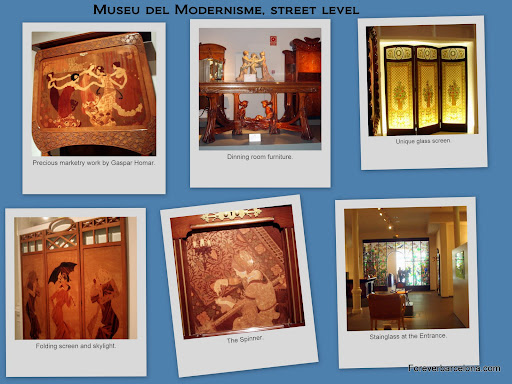
Training seminar: Revisiting Modernism + Visit to the Museu del Modernisme


Continuing with the training sessions organized by the Catalan Gouvernment, this morning I attended a very interesting seminar on Modernism.

The well-known art historian Mireia Freixa gave us a lecture on how Modernisme (Catalan Art Nouveau) has been interpreted through the last century and what are the current new approaches.
Next, her doctorate student Ms. Fátima López told us about a new route on the local industrial past based in the story of the Vilumara family (documented silk merchants in the middle ages, still in the textil industry in the 18 hundreds), and then introduced us to the few pharmacy stores that have preserved their original furniture and decoration from the Modernist times.
I found both speaches very illuminating, and I took some good ideas and resources to add up and enrich my own tours.


But the best part of the training session was visiting the recently open Museu del Modernisme. Ms. Freixa gave us a great tour totally focussed on our "tourguide needs".

This Museum is run by the Pinós family, owners of the Gothland art gallery (the first in town to start dealing with modernist items). A totally private initiative, it is a delicious show based on the private collection on the family that makes a great introduction to the local modernist furniture, painting and sculpture. A must for those wanting to get a closer insight to this exciting period for the history of Barcelona... and neither as far not as long-to-visit as the MNAC, the ultimate museum of Modernism in town.

I trully recomend it, and I hope I'll be including it soon as a regular part of my tours!

By the way, I want to acknowledge Ms. Gema Losa, from the Museu del Modernisme, for allowing me to take these pictures and to publish them.

Saturday, March 6, 2010

Tàpies Foundation finally reopened after 2 years of works


The Tàpies Foundation, a museum created by the local contemporary artist Antoni Tàpies to promote his works as well as to spread contemporary art in Barcelona, has finally reopened after 2 years of being closed for repair works.

This week-end they will have open-doors and offer guided tours to show their renovated venue. Don't miss it!

http://www.fundaciotapies.org

(in the picture, detail of the sculpture "Cloud and chair" that crowns the headquarters of the Tàpies Foundation, in Aragó street between Passeig de Gràcia and Rambla Catalunya).

Wednesday, January 13, 2010

Two events I NEED to check out!

Ok, I'll have to announce it like this or... I might be too late!

Two things I really want to check out and... you should too, if you are in town!

Picasso and Japanese Erotic Prints, until February 14th at the Picasso Museum. Surprising insight to Picasso's private sexual inspirations. Information here.

Outdoor exhibit of Rodin's sculptures including the superfamous The Thinker. Unfortunately I haven't been able to find out how long would be along Rambla Catalunya. See the video here:

Wednesday, May 20, 2009

Gaudí's Pedrera opens to prehistorical guests


The basement of Gaudí's appartment building La Pedrera (nickname for the also known as Casa Milà) is usually closed to the public except for a few private events and just from time to time, special exhibits.

Now is one of the unique ocasions to visit this area that otherwise you'd see only in plaster models in their Espai Gaudí at the attic of the building: the Atapuerca prehistorical discoverings (considered World Heritage by UNESCO) will be on show there until June 28th.

I reccomend you check it out even if you aren't that interested in archeological remains. Gaudí showed off in this space his engineering proficiency by playing with the weights of the building and distributing them radially to create a room with no columns in the middle.

And the Atapuerca fossiles are also really worth! The most ancient human remains in Europe where found there, as well as the best preserved fossile face in the world ("Skull 5") and the most complete pelvis bone (funnily nicknamed... Elvis!). A fascinating trip to the life back to 500,000 years ago!

Plus the entrance is free!

Tuesday, April 7, 2009

Free access to public museums on Sunday afternoon

From April 5th public museums of Barcelona will be free of charge every Sunday from 3pm to 8pm. Until now, they were only free every first Sunday of the month during their whole opening hours (and that will keep happening).

That includes only those museums owned and run by the city council (Picasso, Museum of History of Barcelona - Roman Ruins, Natural Sciencies, Barcelona Design Hub, Barbier-Mueller Pre-Colombian Art, Ceramic and Ethnologic), but they are working to extend the gratuity to other institutions as well.

In the case of the Picasso Museum, remember that during free-entrance times groups and tourguides don't have priority access and tourguides are not allowed to give explanations inside the museum.

Sunday, January 4, 2009

The Maritime Museum for the Gauch family!


Teresa from The Spanish Travel Boutique asked me to take the Gauch family on two city tours. One of them was to include the Maritime Museum. This isn't a usual request for guided tours, so for me it was a pleasure to prepare the visit and show them around.

They were really impressed by the museum:
First of all by the building itself, as it is located in the medieval Royal Shipyards were Catalan boats and ships were built during centuries.
Then, of course for the collection including gorgeous models of all kind of boats, old navigation instruments and maps, and the star of the museum: a wonderful real-size replica of the Royal Galley of John of Austria that battled in Lepanto in 1571.

A very educational and fun tour for the whole family!

Sunday, December 21, 2008

New Temporary Exhibit at the Picasso Museum


A very interesting temporary exhibit will be shown at the Picasso Museum until March 1st, 2009: Living Things, Figure and Still Nature in Picasso.

I went visiting last Friday and found it really interesting and a great complement to the permanent collection of the museum. As our museum is speciallised in the early works of the artist, it doesn't really cover the maturity years of Picasso when he devellopped the cubism and the surrealism. But with this temporary exhibit you'll approach these periods from the point of view of how he worked on objets (figures and still natures), often treating them as if they were human characters.

A great opportunity to enter Picasso's mind and soul!